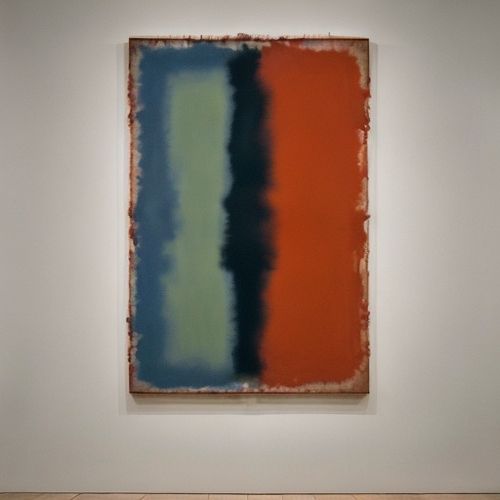
The art world was set abuzz this week when news broke that Mark Rothko’s seminal 1953 painting, No. 61 (Rust and Blue), had been acquired by an anonymous buyer for a staggering $120 million. The sale, conducted through a private transaction brokered by a major auction house, marks one of the most significant deals in recent memory for a postwar abstract masterpiece. While the identity of the collector remains shrouded in secrecy, the purchase has reignited discussions about the soaring valuations of Rothko’s work and the enduring allure of his color-field compositions.
Rothko’s No. 61 is widely regarded as a pinnacle of his signature style—a large-scale canvas dominated by floating rectangular forms that seem to vibrate with emotional intensity. Painted during what many consider the artist’s most fertile creative period, the work exemplifies his mastery of color relationships and spatial ambiguity. The interplay of rust-orange and deep blue hues creates a meditative, almost spiritual effect, a quality that has made Rothko’s paintings perennial favorites among both private collectors and institutions.
The $120 million price tag, while eye-popping, is not entirely surprising given the trajectory of Rothko’s market. His works have consistently commanded eight- and nine-figure sums at auction, with Orange, Red, Yellow fetching $86.9 million in 2012 and No. 10 selling for $81.9 million in 2015. However, private sales of this caliber often exceed public auction results, as they allow high-net-worth individuals to discreetly acquire trophy works without the unpredictability of a bidding war. This latest transaction suggests that demand for Rothko’s most important pieces remains insatiable, even as the broader contemporary art market shows signs of cooling.
Art market analysts speculate that the buyer could be a billionaire from the tech sector, a hedge fund manager, or perhaps a representative of a Middle Eastern or Asian museum seeking to bolster its holdings of Western modernism. The painting’s provenance is equally intriguing: it was last exhibited publicly in 2017 as part of a Rothko retrospective at the Kunsthistorisches Museum in Vienna, and prior to that, it had been held in a private European collection for nearly three decades. The decision to sell now may reflect shifting priorities among heirs or an opportunistic move to capitalize on peak market conditions.
What makes this sale particularly noteworthy is the timing. Coming on the heels of a global pandemic that initially dampened art market activity, the nine-figure deal signals renewed confidence among ultra-wealthy collectors. It also underscores the status of blue-chip artworks as "safe haven" assets—tangible stores of value that appreciate over time regardless of economic volatility. In an era of cryptocurrency crashes and stock market turbulence, masterpieces by artists like Rothko, Pollock, and de Kooning have become the ultimate status symbols and inflation hedges for the 0.1%.
Critics and scholars have long debated whether such astronomical prices distort our understanding of artistic merit. Some argue that the commercialization of Rothko’s work—which he intended as a deeply personal, almost sacred form of expression—runs counter to the artist’s own philosophy. Others counter that the market is simply recognizing what museums and historians have affirmed for decades: that Rothko’s abstractions represent a radical breakthrough in how painting can evoke human emotion. Regardless of where one stands on this debate, there’s no denying that No. 61 now joins the rarefied club of nine-figure artworks that transcend mere commodity status to become cultural landmarks.
The sale also raises questions about accessibility. With yet another major Rothko disappearing into a private collection, opportunities for the public to engage with this pivotal work may become vanishingly rare. While some collectors generously loan their acquisitions to museums, others prefer to keep them hidden in climate-controlled storage or private viewing rooms. This trend has led to calls for greater transparency in the art market and renewed emphasis on institutional acquisitions that ensure public access.
Looking ahead, the $120 million Rothko purchase may well set a new benchmark for postwar American abstraction. As younger collectors enter the market with fresh capital and competing tastes, the enduring appeal of midcentury modernism continues to surprise observers. What seems certain is that as long as there are billionaires seeking to convert wealth into cultural capital, masterworks like No. 61 will keep breaking records—and sparking conversations about art, money, and legacy in the 21st century.
By Daniel Scott/Apr 12, 2025
By Emily Johnson/Apr 12, 2025
By Sarah Davis/Apr 12, 2025
By Ryan Martin/Apr 12, 2025
By Emma Thompson/Apr 12, 2025
By George Bailey/Apr 12, 2025
By Rebecca Stewart/Apr 12, 2025
By Elizabeth Taylor/Apr 12, 2025
By Samuel Cooper/Apr 12, 2025
By James Moore/Apr 12, 2025
By David Anderson/Apr 12, 2025
By George Bailey/Apr 12, 2025
By Sarah Davis/Apr 12, 2025
By Benjamin Evans/Apr 12, 2025
By Michael Brown/Apr 12, 2025
By Victoria Gonzalez/Apr 12, 2025

By David Anderson/Apr 12, 2025
By David Anderson/Apr 12, 2025
By Olivia Reed/Apr 12, 2025
By Rebecca Stewart/Apr 12, 2025